

Table of Contents
Writing a good essay calls on many skills at once critical thinking, research, organization, and clear expression, so if even one of these is shaky, writing becomes much harder. Many students find essay prompts confusing or broad. They may misread the assignment, or feel unsure where to begin. Others have great ideas but struggle to put them in order. Time pressure and fear of failure can make things worse, leading to procrastination and stress. The good news is that each of these challenges can be addressed with simple, practical strategies. By breaking down the task and using clear steps, anyone can improve their writing.
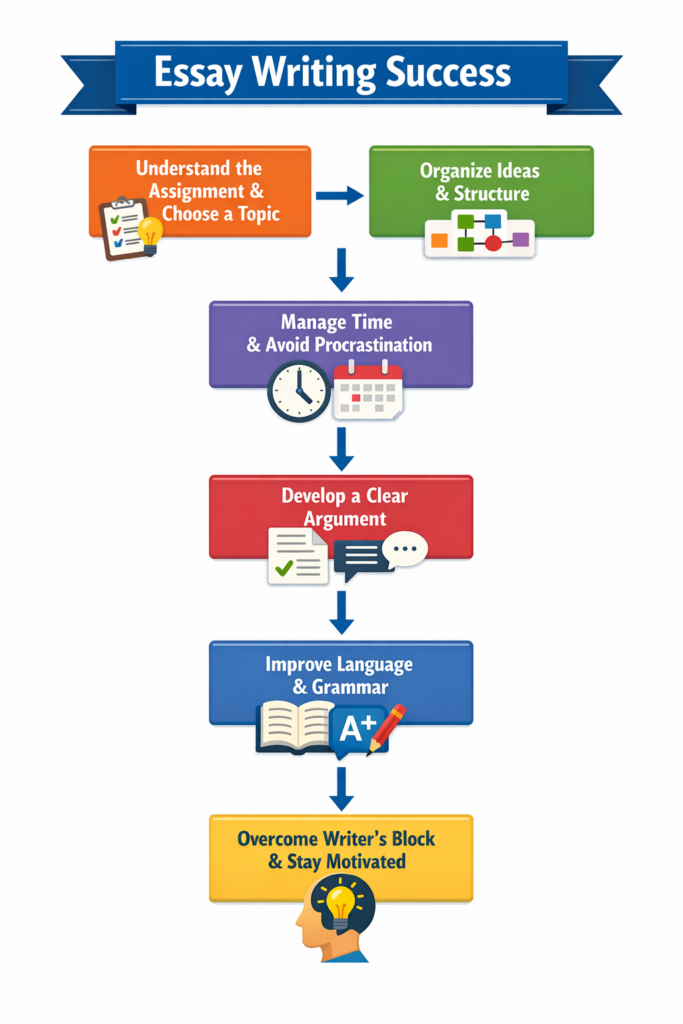
Understanding the Assignment and Choosing a Topic
One common problem is misunderstanding the prompt or topic. If the essay question is unclear, students may write off-topic or only partially answer it. To fix this, read the prompt carefully and highlight key words (such as analyze, compare, or describe). Make sure you know exactly what the teacher is asking: for example, an “analysis” prompt requires critical insight, not just summary. If in doubt, restate the question in your own words or ask your teacher for clarification. Also check for formatting details (word count, citation style) so you don’t lose marks on technicalities.
Once the requirements are clear, choosing a good topic can be easier. If you must pick a topic, think about things you have studied in class. What intrigued or puzzled you? Your topic should be focused enough to cover in your essay’s length. For example, a very broad topic like “World War II” is too large; narrow it to something like “Causes of the U.S. entering World War II” or even more specific. This narrower focus makes research and writing more manageable. Try brainstorming or mind-mapping: list related ideas, then look for a specific question to answer. If you’re still stuck, don’t hesitate to discuss ideas with classmates or a teacher; sometimes a quick conversation can spark the right approach.
Tips:
- Break the prompt into parts: identify the task (what to do) and the topic (what to write about).
- Turn the question into a thesis statement early. This keeps your writing focused.
- If picking your own topic, start broad and narrow down. Ask yourself “who, what, where, when, why” to find a clear angle.
Organizing Ideas and Structure
Many students also struggle with structure. You might have lots of good ideas, but they end up jumbled because there’s no clear plan. This leads to essays that feel confusing or off-track. A helpful fix is to create an outline before writing. An outline lists your introduction, body points, and conclusion with bullet points or short phrases under each. For example:
- Introduction: Hook sentence; some background on the topic; thesis statement.
- Body Paragraph 1: Topic sentence (point 1); evidence or example; explanation.
- Body Paragraph 2: Topic sentence (point 2); evidence; explanation.
- Conclusion: Restate thesis; summarize main points; closing thought.
Using an outline makes your structure clear. As one writing guide notes, planning your structure in advance helps you “work out the main ideas and how you’ll organize them”. It also lets you spot any missing pieces early.
When writing, make sure each paragraph has a clear topic sentence that ties back to your thesis. Good transitions help the reader follow your argument. For instance, words like “however,” “therefore,” or “for example” show how ideas connect. If a paragraph doesn’t support your main argument, consider cutting or revising it. Remember that a strong thesis statement should guide everything you write. Without it, essays often fall into “random points without evidence,” which weakens the argument.
Practical fixes:
- Always start with an outline or at least a list of points you want to cover.
- Use a clear thesis statement in the introduction to guide your writing.
- Begin each paragraph with a topic sentence that relates to the thesis.
- If you feel stuck, try writing bullet points of your argument first, then expand them into full sentences.
Managing Time and Avoiding Procrastination
Time pressure is another big issue. Many students fall behind by waiting until the last minute, then rushing through research, drafting, and proofreading. This often results in lower-quality work and lots of avoidable errors. To manage your time better, start early and create a plan: break the essay into smaller tasks (topic selection, research, outline, draft, revise) and give each a mini-deadline. For example, you might decide to finish your outline two days before the actual due date, leaving time to write and revise.
Techniques like the Pomodoro method (25 minutes of focused work followed by a 5-minute break) can help maintain concentration. Set a timer and commit to writing or researching in each interval. It can also help to schedule “writing appointments” with yourself on your calendar, just like classes or other commitments. A writing center guide recommends “making a realistic plan of action” right after getting your assignment, including marking all due dates and planning check-in points. Use any interim deadlines (for drafts or outlines) that your instructor provides, or make your own.
Time-management tips:
- Highlight any due dates or milestones in your calendar as soon as you get the prompt.
- Divide work into chunks. For example: today find 3 sources; tomorrow write the intro; next day finish the first body paragraph; etc.
- Avoid perfectionism on the first try. It’s okay if your first draft isn’t perfect you’ll improve it later. Just keep moving forward.
- Reward yourself after each task (a short walk, a snack, or a show on break) to stay motivated.
If you find yourself distracted (e.g. by social media or noise), try working in a quiet space or using apps that block distracting sites. Even simple steps like cleaning your desk or planning a specific writing location and time can make a difference.
Developing a Clear Argument
Building a strong argument can be tricky. Common errors include having a vague thesis or no evidence for claims. For instance, a weak essay may simply state opinions without supporting them, or include facts that aren’t explained. This often happens when students haven’t done enough research or haven’t planned how their points fit together.
To improve your argument: Start with a clear thesis statement (the main claim of your essay). Then gather evidence such as facts, quotes, or examples, that directly support each part of that thesis. A good method is the PEEL/TEEL structure for paragraphs: Point, Evidence, Explanation, Link. In each paragraph, make one clear point (Point), back it up with a quote or data (Evidence), explain how it proves your point (Explanation), and link back to your thesis or the next idea.
When evidence seems weak, look for more: use library databases, scholarly articles, or reliable websites. Taking notes during research helps: record the source details and key quotes right away so you can cite them later. As one researcher notes, students often have trouble “developing ideas… [so] the ideas were unclear and the essay looked messy”. To fix this, ask yourself for each paragraph: “Does this support my thesis? Did I explain why this evidence matters?” If not, revise or remove that part.
Argument-development strategies:
- Draft a one-sentence thesis and make sure everything in your essay ties back to it.
- Use specific examples or data to back your claims. Each body paragraph should focus on one sub-point.
- Consider opposing viewpoints briefly and explain why your argument still holds; this can strengthen your case.
- Conclude by linking all points back to the thesis and showing the bigger picture.
Language, Grammar, and Clarity
For ESL learners or students less confident in writing, language issues can slow down the process. Worrying about grammar or word choice during drafting can make you hesitate. A useful tip is “write first, edit later”. Get your ideas down without stopping to correct every grammar mistake. You’ll fix most errors in the revision stage.
After writing a draft, use tools and techniques to improve clarity. Read your essay aloud or have someone else read it – awkward phrasing and mistakes often stand out this way. Grammar and spell-check tools (like those in Word or online tools such as Grammarly) can catch many errors, but don’t rely on them 100%. For example, they might miss correctly spelled words used incorrectly (their/there) or suggest changes that alter meaning.
If vocabulary is a concern, avoid overly complicated words if you’re not sure how to use them. Clarity is more important than showing off big words. It can help to keep a glossary of useful academic phrases or transition words to make writing smoother. For example, use phrases like “In addition,” “However,” “For instance,” to connect ideas. A calm review of style matters too: pick either American or British spelling and stick with it; follow guidelines on comma use; and ensure all quotations and references are correctly formatted.
Language and clarity fixes:
- After drafting, go through one paragraph at a time and check for grammar or vocabulary issues.
- Simplify complex sentences. Academic writing should be clear, not convoluted.
- Use active voice and first person sparingly (unless the assignment allows it) to sound confident and direct.
- If English is not your first language, consider feedback from a tutor or peers who can point out unclear spots.
Overcoming Writer’s Block and Staying Motivated
Almost every writer faces writer’s block at times the feeling that no ideas will come. This is normal. To overcome it, try freewriting: set a timer for 5–10 minutes and write whatever comes to mind about the topic, without worrying about grammar or style. You might jot down even silly ideas, but often this will unstick your mind and lead to useful thoughts. Changing your environment can help too: move to a quieter room, or even a library or café if that suits you.
If you feel overwhelmed or unmotivated, break the project into tiny goals. Instead of “write a 10-page essay,” think “write the introduction paragraph” or “find two quotes for body paragraph 1.” Check off each mini-goal as you complete it to build confidence. Reward yourself when you meet these goals (a short break, a healthy snack, a walk outside) to stay positive. Remember: your first draft doesn’t have to be perfect – you can polish it later. Accepting that drafting is a messy, iterative process can reduce stress.
Lastly, try to connect the essay to something you care about. Even in required assignments, find one angle that interests you. Maybe the topic relates to your field of study, or perhaps you see a personal relevance. Feeling a sense of purpose can make writing feel less like a chore.
In summary, essay writing challenges – like unclear prompts, messy structure, time crunch, or language worries – are common but not insurmountable. By breaking the task into steps (understand the question, plan an outline, write in stages, and revise carefully) and using the strategies above, any student can improve. With practice and persistence, you’ll find writing essays becomes more manageable and even rewarding. Use the resources available (writing centers, tutors, online guides) and keep a positive mindset: every essay you write builds your skills for the next one.