

Table of Contents
The Art of Legal Research
Imagine you’re a lawyer trying to solve a mystery. Legal research is your detective work finding the laws and court decisions that apply to your case. In plain terms, legal research means finding the laws (legal authorities) that apply to your situation (See: https://www.usa.gov/laws-and-legal-research).
It’s about gathering facts, reading statutes and cases, and seeing how they fit together. Whether you’re a solo attorney or a team with a legal researcher, think of legal research and writing as telling a clear story: what happened, what laws apply, and why those laws give you the answer you want. In fact, strong legal research becomes even more crucial in real-world situations involving severe injuries such as traumatic brain injuries where victims may rely on a qualified brain injury attorney to help build a compelling case supported by solid legal authority.
Starting Out? Define Your Question
Before diving into books and databases, get the facts and question straight. Write down the “who, what, when, where, why” of the situation (See: https://www.uscourts.gov/rules-policies). This lets you pinpoint the legal issue. For example, are you dealing with a contract dispute or a traffic ticket? Once you know exactly what question you need to answer, your search becomes focused.
Next, pick the right jurisdiction, the “arena” whose rules govern your issue. Is it state law or federal law? Which state (e.g. Ontario vs. New York)? A helpful rule: a case from one state won’t bind courts in another. Focus on the laws and cases from the proper court system. In practice, lawyers say: narrow the question and stick to the right court or agency before you start reading cases or statutes.
Finding the Right Resources
With the issue clear, it’s time to search for the law. Think of legal research in layers. First, many lawyers begin with secondary sources, summaries and guides that already explain the law and point out important statutes or cases. These could be legal encyclopedias, law review articles, practice guides, or treatises.
For instance, encyclopedias like Corpus Juris Secundum or American Jurisprudence give overviews of legal topics and cite key cases and laws. Similarly, practice guides and law journal articles lay out the main arguments and often “do the hard work for you,” identifying the statutes and rulings involved. These secondary sources are a great jumping-off point because they help you build a quick roadmap of your issue without starting from zero.
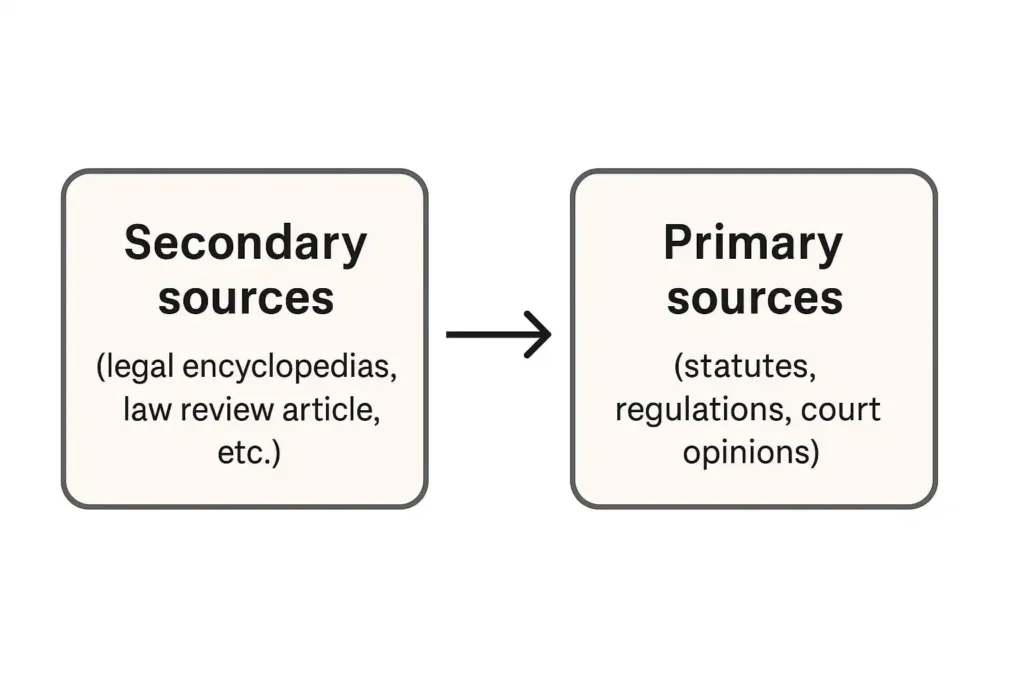
After skimming helpful secondary sources, you move to primary sources, the actual laws and decisions. Primary sources include statutes passed by legislatures, regulations from agencies, and court opinions (cases). For example, you might look up a state code section on landlord-tenant law or a federal appellate court case on product liability. In many research projects, you’ll find that secondary sources have already pointed you to the key statutes and cases, so you just go read those next.
These days, much of this work is done on computers. Instead of digging through dusty law books, attorneys use specialized legal research programs and databases (like Westlaw or LexisNexis) or even free tools (like Google Scholar or government sites). These platforms are designed for law: they let you search by keywords or citation, browse codes, and cross-reference cases. They also often include AI-assisted legal research features. In other words, technology can help you turn the detective’s magnifying glass faster.
If you’re on a tight budget, free resources exist: public law libraries, some state or federal government websites, and services like the Legal Information Institute or FindLaw provide access to codes and cases online. For filing simple court forms or understanding basic procedures, even self-help books or kits can save time. Just remember: secondary resources and self-help guides inform you about the law, but the rules that must be followed are the statutes, regulations, and case law themselves.
Checking Your Findings
Once you’ve collected cases and statutes, make sure they’re still good law. Courts follow the latest decisions. A case that was overturned or a statute ruled unconstitutional can’t support your argument. Here’s where a citator comes in (Shepard’s on LexisNexis, KeyCite on Westlaw, etc.). Citators track the history of a case or law and flag if something negative happened to it. In short, they show whether a case has been reversed, overruled, or criticized.

Even without a formal citator, a quick check of subsequent cases or annotations can help. Many annotated codes list cases interpreting a statute. Law librarians or legal research attorneys often recommend always verifying a key case with such tools. When the same rule pops up in multiple places (statute, case, regulation), it’s usually a sign your answer is settled. In practice, once your research repeatedly points to the same rule in different sources, you can be confident you’ve found the law you need.
Key Takeaways and Tips
- Begin with clarity. Always start by writing out the question, facts, and what outcome you want. This keeps research focused.
- Use strong sources. Start with legal encyclopedias, guides, and treatises for an overview (they list relevant laws and cases). Then go to the actual statutes, regulations, and case law.
- Know your tools. Modern legal research programs (like Westlaw and Lexis) let you drill down faster than a generic web search. They have advanced features – even AI – to help find related cases and interpret laws.
- Understand citations. Learn how case citations work (e.g., 410 U.S. 113 points to volume 410 of the U.S. Reports, page 113) and statute citations (like 42 U.S.C. §1983 for a federal law). This lets you locate sources quickly.
- Check jurisdiction and procedure. Make sure you’re looking up the right state’s laws or the correct federal rules. Also remember to consult court rules (like local court rules or federal rules of civil procedure) for deadlines and formats.
- Don’t forget the librarians. Public law libraries and court clerks often have guides and advice. A librarian can suggest useful resources or show how to use a citator or database. In fact, California Courts’ self-help guide recommends starting with a self-help book and getting help from a law librarian to “check if a law or case you are using is still valid.”
- Be complete. Stop researching when every reliable source points to the same answer. When the same legal rule emerges from statutes, cases, and secondary sources, and citations are all in agreement, you’ve likely found the complete picture.
FAQs
What skills are required for legal research for lawyers?
Lawyers must be curious and organized. They need to break down facts, ask clear questions, and know where to look for answers. Essential skills include understanding how to use legal databases and libraries, recognizing the right sources (cases, statutes, regulations), and knowing how to cite and analyze those sources.
Good legal research also requires reading skills to parse dense legal language, critical thinking to apply law to facts, and precise writing to summarize findings. As the California Courts guide notes, starting with a clear statement of “what laws apply to that situation” is key. In practice, being patient and systematic keeping track of searches, sources, and notes is just as important as having technical know-how.
What is advanced legal research?
Advanced legal research goes beyond simple keyword searches. It often involves using specialized tools and strategies, like sophisticated legal research programs and AI-powered assistants, to uncover obscure or highly technical information. For example, lawyers might use specialized practice guides, historical archives of legislation, or analytics software that identifies patterns in case law.
Advanced research also means double-checking everything with citators or legislative histories, and sometimes reaching out to experts or performing cross-jurisdictional comparisons. With AI models and analytics emerging, “advanced” can even mean letting an AI sift through millions of documents to find hidden connections. In short, advanced research combines deep legal knowledge with cutting-edge technology to ensure no relevant law is missed.
How do you conduct legal research?
Follow the steps:
(1) Ask the right question. Write down the facts and the specific legal issue.
(2) Find secondary sources. Look up overviews in legal encyclopedias, treatises, or law review articles. These will point you to key statutes and cases.
(3) Find primary law. Using those leads, retrieve the actual statutes, regulations, and court opinions on point.
(4) Use research tools. Employ online databases (Westlaw, Lexis, government websites) and search terms strategically.
(5) Verify the law. Check each case and statute is still good by using citators or later decisions.
(6) Synthesize and write. Combine your findings into a clear explanation (this is where legal research and writing converge). Throughout, keep track of sources and take notes. The goal is to answer the question with authority, using the most current and relevant laws you can find.
Special Thanks:
This article includes insights supported by data contributed by PelzLawGroup whose experience in real-world injury cases helps highlight the importance of accurate and thorough legal research.


Comments
Write more, thats all I have to say. Literally, it seems as though you relied on the video to make your point.
You definitely know what youre talking about, why throw away your intelligence on just posting
videos to your blog when you could be giving us something
informative to read?
With havin so much written content do you ever
run into any issues of plagorism or copyright
violation? My blog has a lot of completely unique content I’ve either written myself or outsourced
but it seems a lot of it is popping it up all over
the internet without my authorization. Do you
know any ways to help reduce content from being ripped off?
I’d definitely appreciate it.
Hi there! I’m at work surfing around your blog from my new iphone 3gs!
Just wanted to say I love reading through your blog and look forward to all
your posts! Carry on the superb work!
I every time spent my half an hour to read this web site’s
content daily along with a cup of coffee.
Author
We appreciate that you find our blog engaging, stay tuned for more content to come
Usually I do not learn post on blogs, but I would like to say that this write-up very compelled me to take a look at and
do so! Your writing style has been surprised me. Thanks, quite nice
article.